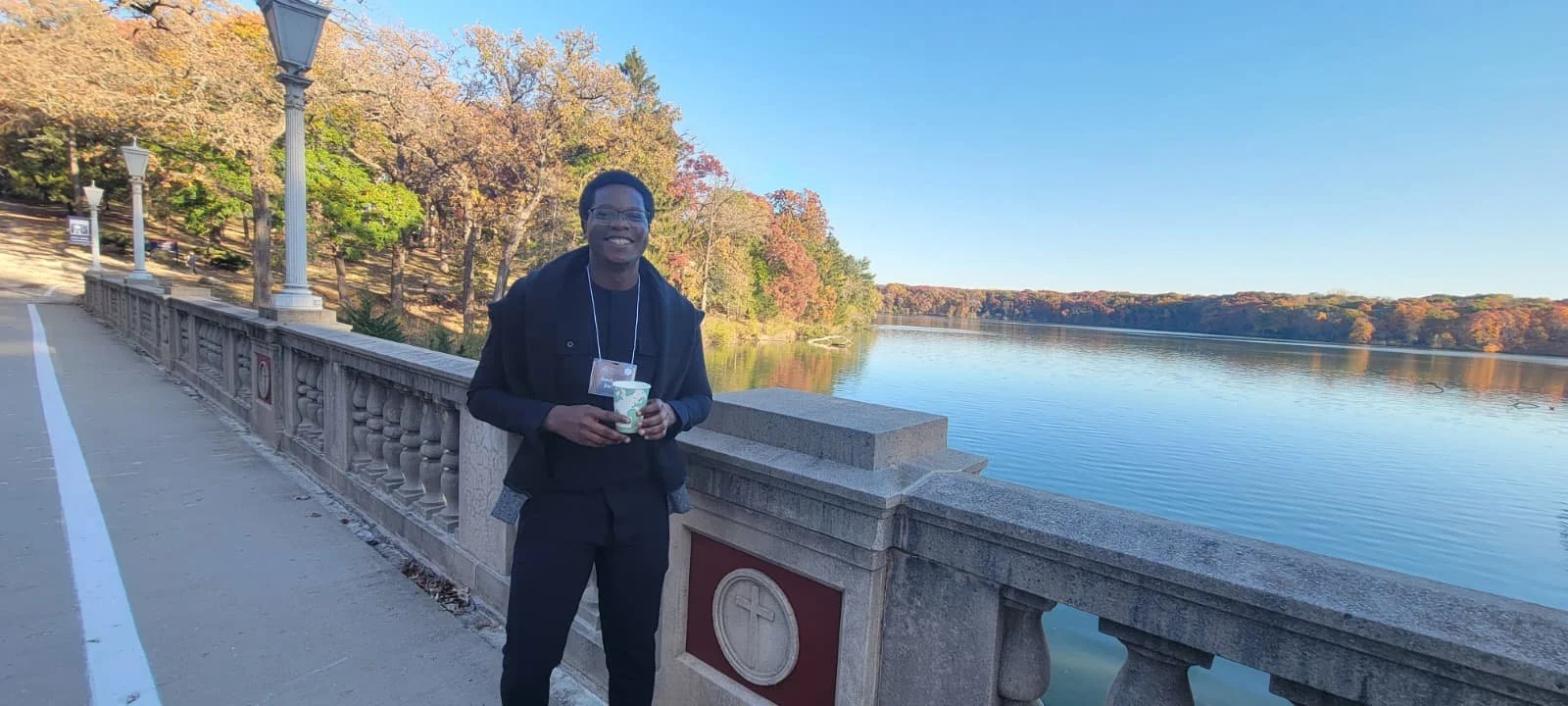
Short bio
I am a philosopher of education and Assistant Professor of Education at Canadian Mennonite University in Winnipeg. My work asks what schools and universities are for, and how they form intellectual and moral character together. I bring Aristotelian virtue ethics into conversation with the Yorùbá ideal of Omolúàbí to rethink the ethical and epistemic foundations of education. My first monograph, Intellectual and Moral Formation in Higher Education: What Universities Are For, is forthcoming with Bloomsbury Academic.
long Bio
Research
I am a philosopher of education. My research asks how education forms the intellect and the character together, and what that means for teachers, students, and the institutions that serve them. I work across virtue epistemology, relational ethics and pedagogy, liberal and democratic education, teacher education, moral education, African philosophy, and epistemic justice.
At the centre of my work is a sustained conversation between classical and African intellectual traditions. My doctoral dissertation, From Aristotle to Omolúàbí: Rethinking Intellectual and Moral Virtues in Contemporary University Education, reads Aristotelian virtue ethics alongside the Yorùbá ideal of the Omolúàbí, the person of good character. It reconstructs virtue epistemology through African philosophy and critical pedagogy to argue for a global ethics of education. I completed it at Queen’s University in 2026 under the supervision of Dr David Bakhurst.
I also study education in contexts of conflict, trauma, and resistance. As a Graduate Research Fellow on a SSHRC-funded project led by Dr Thashika Pillay, I worked with colleagues on how young people in Tigray, Ethiopia, formed identity and solidarity during war and genocide. A Mastercard Foundation-funded evaluation of community-based rehabilitation programming deepened my commitment to disability inclusion.
My newer work turns to artificial intelligence and human formation. I ask what happens to intellectual virtue, trust, and relationship when machines begin to think for us, and what teacher education should do about it. Looking ahead, I am developing African epistemologies as foundations for transnational educational justice, relational ethics, and the moral purposes of the university in a global age.
I have presented this work across North America, Europe, and Africa. Venues include the Philosophy of Education Society, the North American Association for Philosophy and Education, the Canadian Philosophy of Education Society, the Comparative and International Education Society of Canada, the Canadian Association of African Studies, the Lagos Studies Association, and the British Association for International and Comparative Education.
Publications
My first monograph, Intellectual and Moral Formation in Higher Education: What Universities Are For, is forthcoming with Bloomsbury Academic. My article “Cultivating Minds and Hearts: The Moral Dimensions of Intellectual Virtues in Higher Education” is forthcoming in Philosophy of Education. It was nominated for the Philosophy of Education Society’s 2025 Outstanding Paper Award. A chapter on the global genealogies of the university is in press in Beyond Economics: Revaluing Universities and Higher Education (Routledge, 2027).
My other work appears in the Oxford Review of Education, the International Journal for Educational Integrity, the Journal of Contemporary Issues in Education, the Canadian Journal of Education, and the Journal of Critical Race Inquiry. I have contributed chapters to volumes from Michigan State University Press and Cambridge Scholars Publishing. My co-authored article “Human Rights Are Not for Black Peoples” (2025) draws on our research with young adults in Tigray. Several new manuscripts on artificial intelligence, teacher education, and intellectual trust are currently under review.
I also write for public audiences. My pieces have appeared in the Nigerian Tribune and the Queen’s Faculty of Education Knowledge Forum, and my poem “The Advocate” appears in a Roseway Publishing anthology on working life in the climate crisis.
Teaching
I teach in the Bachelor of Education program at Canadian Mennonite University. My courses include Inclusive Education, Anti-oppressive Education and Culturally Responsive Pedagogies, Methods in History and Social Studies, Hands-on Approaches to Science and Math, Technological and Media Literacy, and Pedagogies of Peace and Justice. I also support teacher candidates in their final practicum.
At Queen’s University, I was instructor of record for History and Philosophy of Education. I taught it to the community-based Indigenous Teacher Education Program as well as French as a Second Language and Technological Education cohorts. Before that, I assisted and co-taught at the University of Ibadan with Dr Christopher Omoregie and Dr Kola Babarinde. Those courses included History of Educational Ideas, Social and Cultural Contexts of Education, Introduction to Philosophy, Historical and Philosophical Methods in Education, and several courses in the philosophy of adult education.
My teaching began in secondary schools in Nigeria. I taught English, literature, and government, served as Head of Arts and Humanities, and was named Tutor of the Year in 2017. In Kingston, I also worked as an Education Assistant in elementary and secondary schools. These classrooms taught me that good teaching is relational. I try to build classrooms where students reason carefully, listen generously, and bring their own knowledge to the table.
Editorial work and service
I was Founding Editor-in-Chief of the Queen’s Journal of Education and Managing Editor of Research in a Nutshell. I served as a copyeditor for Bloomsbury’s four-volume International Handbook Series on Leadership in Higher Education in Times of Crises and Change. I review for journals including the Journal of Philosophy of Education, Global Philosophy, and Frontiers in Education, for Bloomsbury Academic, and for conferences including the American Educational Research Association.
At Canadian Mennonite University, I serve on the University Senate and the Faculty Research Committee. I am a member of the Development Committee of the Philosophy of Education Society of Great Britain. At Queen’s, I was the first Black and African President of PSAC Local 901, representing more than 2,000 graduate students and postdoctoral scholars. I also co-chaired the Faculty of Education’s Joint Health and Safety Committee. Beyond the university, I served on Correctional Service Canada’s Ontario Regional Ethnocultural Advisory Committee and as Vice-Chair of the Kingston Racialized Members Committee.
Community
I founded Ìmọ̀ Futures, a global education initiative that connects learners and institutions in Canada and Nigeria. I have coordinated laptop donations to students and community organizations in Kingston and Lagos and funded schooling support for young learners in Ibadan. I am also a mentor in the Black Youth Mentorship and Leadership Program at the University of Calgary.
Background and recognition
I hold a PhD in Education from Queen’s University (2026). I earned a Master of Education in Philosophy of Education and a Bachelor of Education in Adult Education and Political Science at the University of Ibadan. There I wrote on Martin Buber’s existentialism and on community education. I speak Yorùbá, English, and Nigerian Pidgin.
My work has been supported by the Walter F. Light Graduate Fellowship, the Queen’s University Graduate Award, and the Frank Wyatt McLean/Education Graduate Expansion Award. It has also received large and small grants from the Philosophy of Education Society of Great Britain. I am an active member of the Canadian Philosophy of Education Society, the Philosophy of Education Society of Great Britain, the North American Association for Philosophy and Education, the John Dewey Society, and the Canadian Society for the Study of Education.
Across my research, teaching, and service, one question keeps me going. How can education form people who think well, live well, and do justice to one another and to the knowledge of every people?