When Did We Start Measuring Education by Money?
I did not intend to write this. I had just finished the teaching component of a course with teacher candidates at my institution and was looking forward to taking a short break before turning to assessment and the next things on my academic calendar. But a troubling conversation I encountered online would not leave me alone. It began with a debate in Nigeria about what rapper Ycee called the “Olodo Uprising.” His comments were framed around what he saw as a growing celebration of ignorance, internet virality, and celebrity at the expense of education and intellectual achievement. The debate quickly became associated with Peller, the popular Nigerian streamer and content creator whose success and enormous following have made him a significant figure among young Nigerians.
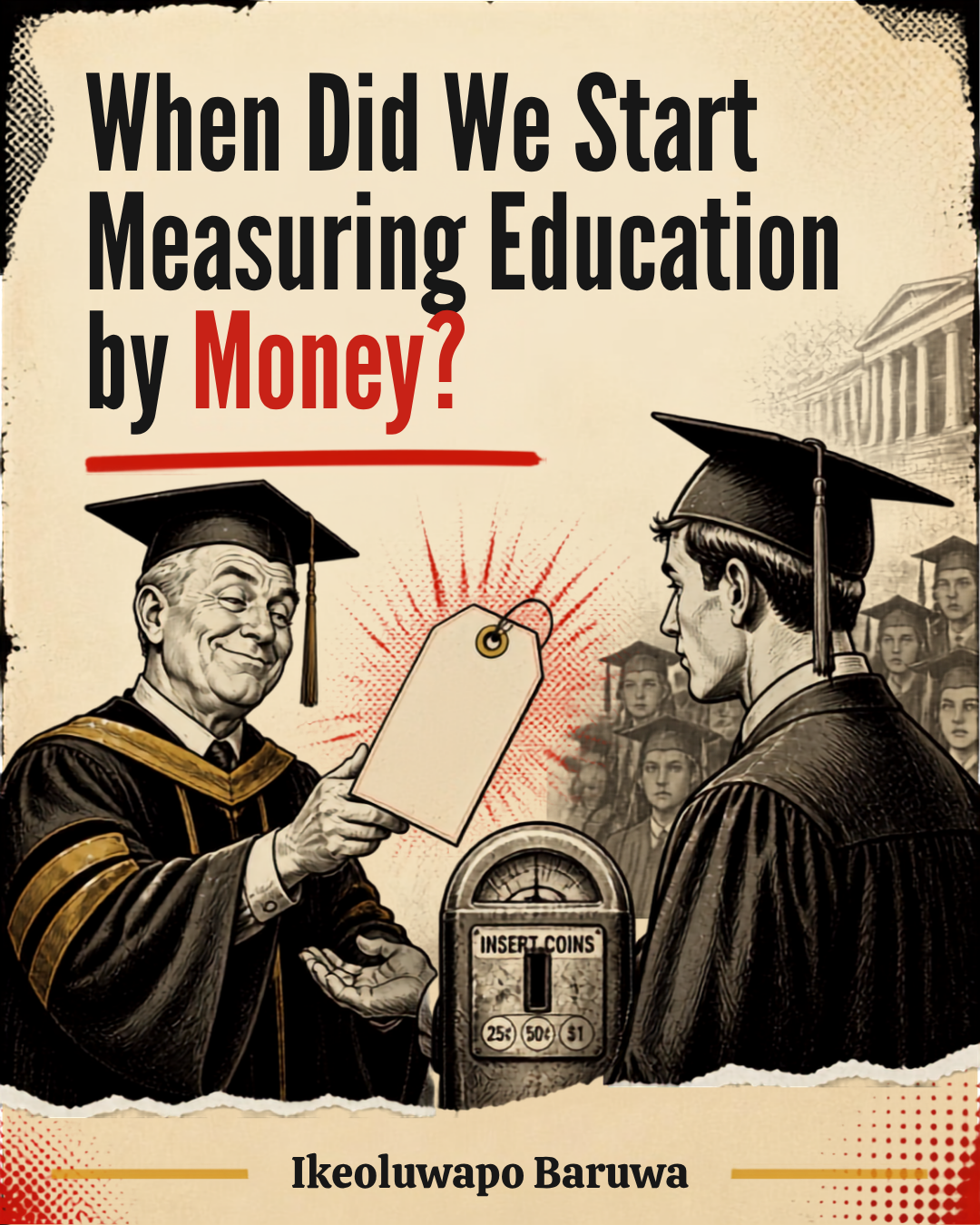
I do not want this essay to become another argument about Peller. Peller is not really the problem. Neither, for that matter, is Ycee. What interests me is what this controversy reveals about something much deeper. What exactly have we come to mean by education, success, and a life well lived? I ask this because I think we may have gradually reduced three things that ought to remain distinct. We have reduced education to employment, success to money, and intellectual achievement to visible economic output. And perhaps artificial intelligence is now forcing us to confront the consequences of those reductions.
There is something understandable about the Nigerian celebration of financial success. For many people, money is not simply a symbol of status. It is the difference between security and insecurity. It can mean food, housing, healthcare, supporting one’s parents, paying school fees, or giving one’s children opportunities that were unavailable to oneself. So I do not want to romanticize poverty. Money matters. But money cannot be the whole meaning of success. A person can be wealthy without flourishing. A person can be famous without flourishing. A person can have millions of followers without flourishing. And a person can earn a modest income while living an intellectually rich, morally serious, relationally meaningful, and socially valuable life. This distinction matters because our public conversations increasingly seem to confuse what is valuable with what is valuable in the market. If something makes money, we call it successful. If something attracts followers, we call it successful. If something produces a product, we call it innovative. If something does not generate an obvious economic return, we are increasingly tempted to ask what its value is. Education has not escaped this logic.
I grew up hearing a Yoruba children’s song, “Bata rẹ̀ a dùn kó-kó-ká, bí o bá kàwé rẹ̀...” that celebrated education and connected it with the hope of a better future. The message was familiar. Study hard, become educated, and you will have a better future. There was wisdom in that message. Education can open doors. It can expand our knowledge and imagination. It can create opportunities, enable social mobility, and give people intellectual resources with which to understand and transform their circumstances. But somewhere along the way, something happened. The promise of education became increasingly tied to employment. Employment became tied to income. Income became tied to success. And success became increasingly tied to wealth and visibility. We therefore began to ask a very different question. Not, “What kind of person is this education helping me become?” But, “What job will this education get me?”
That is not an insignificant question. In a society where unemployment and underemployment remain serious problems, it would be irresponsible to pretend otherwise. But perhaps it is not the only question. This is where the Nigerian situation becomes complicated. We tell young people that education is the route to a better life. Parents make enormous sacrifices to send their children to school. Students study hard, obtain degrees, complete professional qualifications, and enter the labour market expecting that their education will translate into a better life. Then many discover that the degree does not guarantee employment. That frustration is real.
The Peller controversy brought some of this frustration into public view. The wider debate has involved not only questions about Peller’s treatment of degree holders but also the predicament of educated Nigerians who struggle to find employment despite their qualifications. We should listen to that frustration. But we should be careful about the conclusion. If a person studies for years and cannot find a job, it does not necessarily follow that the education was worthless. It may instead tell us something about the society in which that education is being pursued. Perhaps we have asked education to solve an employment problem that education alone cannot solve. Perhaps the failure is partly in the economy, the labour market, public policy, institutions, and the relationship between education and work. And perhaps we have also forgotten that education has purposes that exceed employment.
This is where I become uncomfortable with both sides of the current argument. One side sometimes seems to suggest that people without formal education are unintelligent or unserious. The other side sometimes responds by pointing to successful people without degrees and asking what the degree was worth. Neither argument gets us very far. Someone can succeed without university education. Someone can succeed because of university education. Someone can fail despite university education. Someone can fail without it. None of these cases tells us what education itself is for.
There have always been other ways of learning and developing a livelihood. Apprenticeship, craft learning, entrepreneurship, family-based learning, and other forms of practical education existed long before the expansion of Western schooling. These pathways should not be romanticized. But neither should they automatically be treated as inferior because they do not produce a university certificate. The question should be what kind of knowledge, capacities, character, and opportunities each pathway develops. That brings us back to a more fundamental question. What is education supposed to do to a human being?
This brings me to another assumption that has emerged from these debates. There is an increasing tendency to ask what a PhD holder has actually invented. Where is the product? Where is the app? Where is the technology? Where is the business? What have you created that people can see? There is nothing wrong with these questions in themselves. Some doctoral programmes should absolutely encourage practical innovation. China provides an interesting example. In 2024, China introduced a framework allowing certain engineering professional doctorate candidates to complete their degrees through substantial practical achievements rather than a conventional thesis. These achievements can include products, software, designs, technical standards, patents, and other significant innovations. The pathway is specifically associated with engineering professional degrees and is intended to develop engineers capable of solving complex real-world problems. Nature reported in July 2026 that more than 60 doctoral candidates had graduated through this practical achievement route.
That is an interesting development. But it does not mean that every PhD should now be judged by whether the candidate has invented something tangible. A doctorate can involve practical innovation. It can also involve theoretical innovation, conceptual innovation, methodological innovation, historical interpretation, philosophical argument, new empirical knowledge, a new way of understanding an old problem, or a framework that changes how others think about a question. These are not lesser contributions because they cannot be held in one’s hand. The Chinese example actually makes the distinction clearer. Its practical achievement route applies to particular professional engineering doctorates. It is not a universal replacement for the scholarly purposes of doctoral education. The official Chinese guidelines themselves distinguish between thesis-based and practice-based routes and require the latter to demonstrate innovation, independent professional capacity, practical application, and meaningful contribution to engineering practice. The point, then, is not that every PhD must build something. The point is that a PhD should make a serious contribution appropriate to its field.
I also want to be clear about something. A PhD does not make a person more valuable than someone without one. The letters after someone’s name do not automatically make that person wise, ethical, intelligent, creative, or useful. There are bad PhDs. There are weak doctoral programmes. There are institutions whose standards deserve serious scrutiny. There are people who possess impressive credentials without possessing the intellectual qualities those credentials are supposed to represent. We should be able to say this without embarrassment. But the opposite error is equally serious. The existence of bad PhDs does not make intellectual achievement irrelevant. We do not conclude that medicine is useless because some doctors are incompetent. We do not conclude that journalism is useless because some journalists are irresponsible. We do not conclude that entrepreneurship is useless because some businesses fail. We scrutinize the standards. We improve the institutions. We demand better work. We do not throw away the underlying ideal.
And now the argument becomes even more complicated. Artificial intelligence is making it possible for machines to perform increasingly sophisticated forms of writing, analysis, coding, image production, research assistance, translation, and other forms of cognitive work. This should concern education. But I am not persuaded that the answer is to conclude that intellectual development therefore matters less. If anything, it should force us to ask a more difficult question. What happens to education when machines become extraordinarily good at producing the kinds of outputs we once used as evidence of human intelligence?
This is where much of the conversation about becoming “AI-proof” seems incomplete. We are told that humans should develop creativity, critical thinking, communication, empathy, collaboration, and other capacities that AI cannot easily replace. That may be useful advice. But it leaves us with a problem. What happens when AI becomes better at some of those things too? If creativity is what makes us human today, what happens when machines become increasingly creative? If reasoning is what makes us human today, what happens when machines outperform us in increasingly sophisticated forms of reasoning? If emotional responsiveness becomes our refuge, what happens when machines become extraordinarily convincing at simulating it? We could spend our lives moving the boundary between the human and the machine. Perhaps we are asking the wrong question.
Instead of asking only what humans can do that machines cannot, perhaps education should ask a deeper question. What kind of human beings should we become in a world where machines can increasingly do what humans once considered uniquely our own? This is where human formation becomes important. Education is not simply about producing outputs. It is about forming people who can judge, discern, deliberate, relate, take responsibility, pursue what is worthwhile, and live meaningfully with others. A student can use AI to produce an excellent essay. But has the student become a better thinker? A teacher can use AI to generate a lesson plan. But has the teacher become more attentive to the particular students in the room? A researcher can use AI to summarize hundreds of articles. But has the researcher developed better judgment about which questions are worth asking? A doctor can use AI to assist with diagnosis. But has the doctor developed the wisdom and moral responsibility required to care for a particular human being?
These questions take us beyond performance. They take us toward formation. Interestingly, this is not a concern limited to a few philosophers of education. The OECD’s 2025 framework on education and human flourishing explicitly argues that education should move beyond a narrow human capital model and cultivate purpose, ethical competence, human agency, meaning, and the capacity to flourish in an age of AI. That does not settle the question. But it tells us that the question is worth asking.
I began with a debate about Peller. I now think Peller is almost incidental. His success tells us something about contemporary Nigerian society, particularly about the economic and cultural value we place on visibility, entertainment, entrepreneurship, and social connection. But his success cannot tell us whether education matters. Nor can the success of a professor. Nor the success of a doctor. Nor the success of a billionaire. Nor the success of someone with no formal education. We need a richer language. I would call that language human flourishing. Success should certainly be able to include financial security. It should include meaningful work. It should include achievement. But it should also include intellectual growth, moral character, meaningful relationships, contribution to others, participation in community, and the capacity to live a life that is genuinely worth living. This is not an argument against ambition. It is an argument about what ambition should serve.
Artificial intelligence is forcing us to reconsider many things. It is forcing us to reconsider work. It is forcing us to reconsider expertise. It is forcing us to reconsider creativity. It is forcing us to reconsider knowledge. It is forcing us to reconsider education. But perhaps most importantly, it is forcing us to reconsider ourselves. If machines can increasingly write, calculate, analyse, design, generate, and produce, then perhaps our response should not be to panic about which human skill remains safely beyond the reach of technology.
Perhaps we should ask a more fundamental question. What kind of human being are we trying to form? This question takes us beyond Peller. It takes us beyond PhDs. It takes us beyond certificates. It takes us beyond salaries. It takes us beyond artificial intelligence itself. Education should not merely produce people who can compete with machines. It should help form people who know what is worth pursuing, how to live with others, how to exercise judgment, how to use knowledge responsibly, and how to contribute to a world in which other human beings can also flourish. Perhaps that is why education remains important even when education cannot guarantee employment. That is why intellectual work remains important even when machines can reproduce some of its outputs. And perhaps that is why we need to recover a richer understanding of success. Maybe this is when humanism matters.
