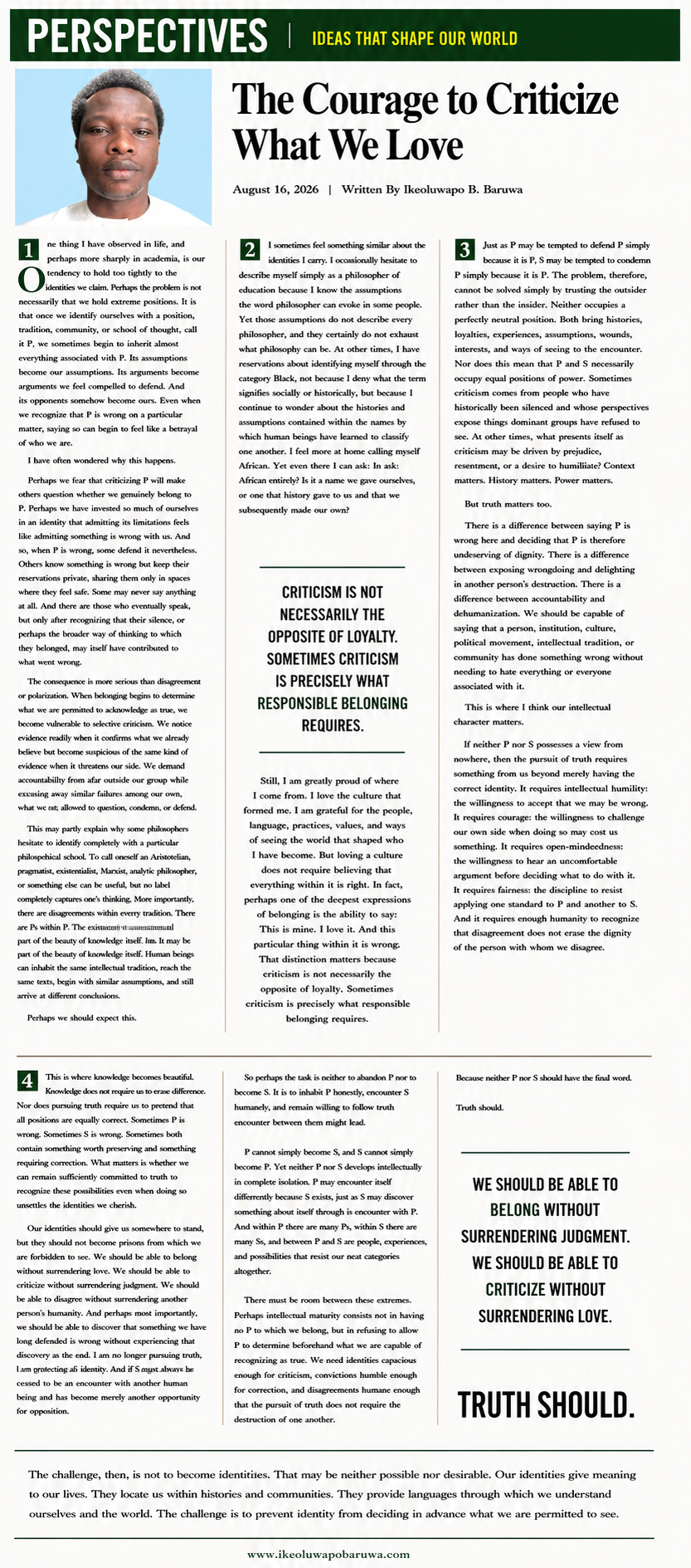
The Courage to Criticize What We Love
The courage to criticize what we love, an image by Ikeoluwapo Baruwa
One thing I have observed in life, and perhaps more sharply in academia, is our tendency to hold too tightly to the identities we claim. Perhaps the problem is not necessarily that we hold extreme positions. It is that once we identify ourselves with a position, tradition, community, or school of thought, call it P, we sometimes begin to inherit almost everything associated with P. Its assumptions become our assumptions. Its arguments become arguments we feel compelled to defend. And its opponents somehow become ours. Even when we recognize that P is wrong on a particular matter, saying so can begin to feel like a betrayal of who we are.
I have often wondered why this happens.
Perhaps we fear that criticizing P will make others question whether we genuinely belong to P. Perhaps we have invested so much of ourselves in an identity that admitting its limitations feels like admitting something is wrong with us. And so, when P is wrong, some defend it nevertheless. Others know something is wrong but keep their reservations private, sharing them only in spaces where they feel safe. Some may never say anything at all. And there are those who eventually speak, but only after recognizing that their silence, or perhaps the broader way of thinking to which they belonged, may itself have contributed to what went wrong.
The consequence is more serious than disagreement or polarization. When belonging begins to determine what we are permitted to acknowledge as true, we become vulnerable to selective criticism. We notice evidence readily when it confirms what we already believe but become suspicious of the same kind of evidence when it threatens our side. We demand accountability from those outside our group while explaining away similar failures among our own. At its worst, identity begins to decide beforehand what we are allowed to question, condemn, or defend.
This may partly explain why some philosophers hesitate to identify completely with a particular philosophical school. To call oneself an Aristotelian, pragmatist, existentialist, Marxist, analytic philosopher, or something else can be useful, but no label completely captures one’s thinking. More importantly, there are disagreements within every tradition. There are Ps within P. The existence of these internal differences is not necessarily a weakness. It may be part of the beauty of knowledge itself. Human beings can inhabit the same intellectual tradition, read the same texts, begin with similar assumptions, and still arrive at different conclusions.
Perhaps we should expect this.
I sometimes feel something similar about the identities I carry. I occasionally hesitate to describe myself simply as a philosopher of education because I know the assumptions the word philosopher can evoke in some people. Yet those assumptions do not describe every philosopher, and they certainly do not exhaust what philosophy can be. At other times, I have reservations about identifying myself through the category Black, not because I deny what the term signifies socially or historically, but because I continue to wonder about the histories and assumptions contained within the names by which human beings have learned to classify one another. I feel more at home calling myself African. Yet even there I can ask: Is African entirely ours? Is it a name we gave ourselves, or one that history gave to us and that we subsequently made our own?
Still, I am greatly proud of where I come from. I love the culture that formed me. I am grateful for the people, language, practices, values, and ways of seeing the world that shaped who I have become. But loving a culture does not require believing that everything within it is right. In fact, perhaps one of the deepest expressions of belonging is the ability to say: This is mine. I love it. And this particular thing within it is wrong. That distinction matters because criticism is not necessarily the opposite of loyalty. Sometimes criticism is precisely what responsible belonging requires.
If I belong to P and P does wrong, I should be able to rebuke P without ceasing to belong to it. Indeed, concealing what is wrong merely because I love P may ultimately do P more harm than good. I should also be able to defend what remains beautiful and truthful within P without pretending that its failures do not exist. P is incomplete. Perhaps every human tradition is incomplete—always somewhere on a journey toward a completeness it may never finally possess.
But there is another side to this.
Suppose there is S, standing outside P. S may see something about P that those within P cannot see. The fact that S does not belong to P does not automatically make S’s criticism false. Truth does not become false because it comes from an outsider.
But S has an identity too.
Just as P may be tempted to defend P simply because it is P, S may be tempted to condemn P simply because it is P. The problem, therefore, cannot be solved simply by trusting the outsider rather than the insider. Neither occupies a perfectly neutral position. Both bring histories, loyalties, experiences, assumptions, wounds, interests, and ways of seeing to the encounter. Nor does this mean that P and S necessarily occupy equal positions of power. Sometimes criticism comes from people who have historically been silenced and whose perspectives expose things dominant groups have refused to see. At other times, what presents itself as criticism may be driven by prejudice, resentment, or a desire to humiliate? Context matters. History matters. Power matters.
But truth matters too.
There is a difference between saying P is wrong here and deciding that P is therefore undeserving of dignity. There is a difference between exposing wrongdoing and delighting in another person’s destruction. There is a difference between accountability and dehumanization. We should be capable of saying that a person, institution, culture, political movement, intellectual tradition, or community has done something wrong without needing to hate everything or everyone associated with it.
This is where I think our intellectual character matters.
If neither P nor S possesses a view from nowhere, then the pursuit of truth requires something from us beyond merely having the correct identity. It requires intellectual humility: the willingness to accept that we may be wrong. It requires courage: the willingness to challenge our own side when doing so may cost us something. It requires open-mindedness: the willingness to hear an uncomfortable argument before deciding what to do with it. It requires fairness: the discipline to resist applying one standard to P and another to S. And it requires enough humanity to recognize that disagreement does not erase the dignity of the person with whom we disagree.
The challenge, then, is not to become identityless. That may be neither possible nor desirable. Our identities give meaning to our lives. They locate us within histories and communities. They provide languages through which we understand ourselves and the world. The challenge is to prevent identity from deciding in advance what we are permitted to see. P cannot simply become S, and S cannot simply become P. Yet neither P nor S develops intellectually in complete isolation. P may encounter itself differently because S exists, just as S may discover something about itself through its encounter with P. And within P there are many Ps; within S there are many Ss; and between P and S are people, experiences, and possibilities that resist our neat categories altogether.
Perhaps this is where knowledge becomes beautiful.
Knowledge does not require us to erase difference. Nor does pursuing truth require us to pretend that all positions are equally correct. Sometimes P is wrong. Sometimes S is wrong. Sometimes both contain something worth preserving and something requiring correction. What matters is whether we can remain sufficiently committed to truth to recognize these possibilities even when doing so unsettles the identities we cherish.
Our identities should give us somewhere to stand, but they should not become prisons from which we are forbidden to see. We should be able to belong without surrendering judgment. We should be able to criticize without surrendering love. We should be able to disagree without surrendering another person’s humanity. And perhaps most importantly, we should be able to discover that something we have long defended is wrong without experiencing that discovery as the destruction of ourselves. For if P must always be right because I am P, then I am no longer pursuing truth; I am protecting an identity. And if S must always be wrong because S is not P, then disagreement has ceased to be an encounter with another human being and has become merely another opportunity for opposition.
There must be room between these extremes.
Perhaps intellectual maturity consists not in having no P to which we belong, but in refusing to allow P to determine beforehand what we are capable of recognizing as true. We need identities capacious enough for criticism, convictions humble enough for correction, and disagreements humane enough that the pursuit of truth does not require the destruction of one another.
So perhaps the task is neither to abandon P nor to become S.
It is to inhabit P honestly, encounter S humanely, and remain willing to follow truth wherever the encounter between them might lead.
Because neither P nor S should have the final word.
Truth should.